The working side of Cam Ranh bay is a morning, not a day, and it goes in this order: Ba Ngòi market before eight, when the night boats have landed; the salt pans south of the town while the light is still low enough to see the workers; the lobster rafts from the road out to Bình Lập; then a lunch you have priced by the kilo before anyone lit a burner. It is the part of the bay that earns its living, and it is the part I go back to.
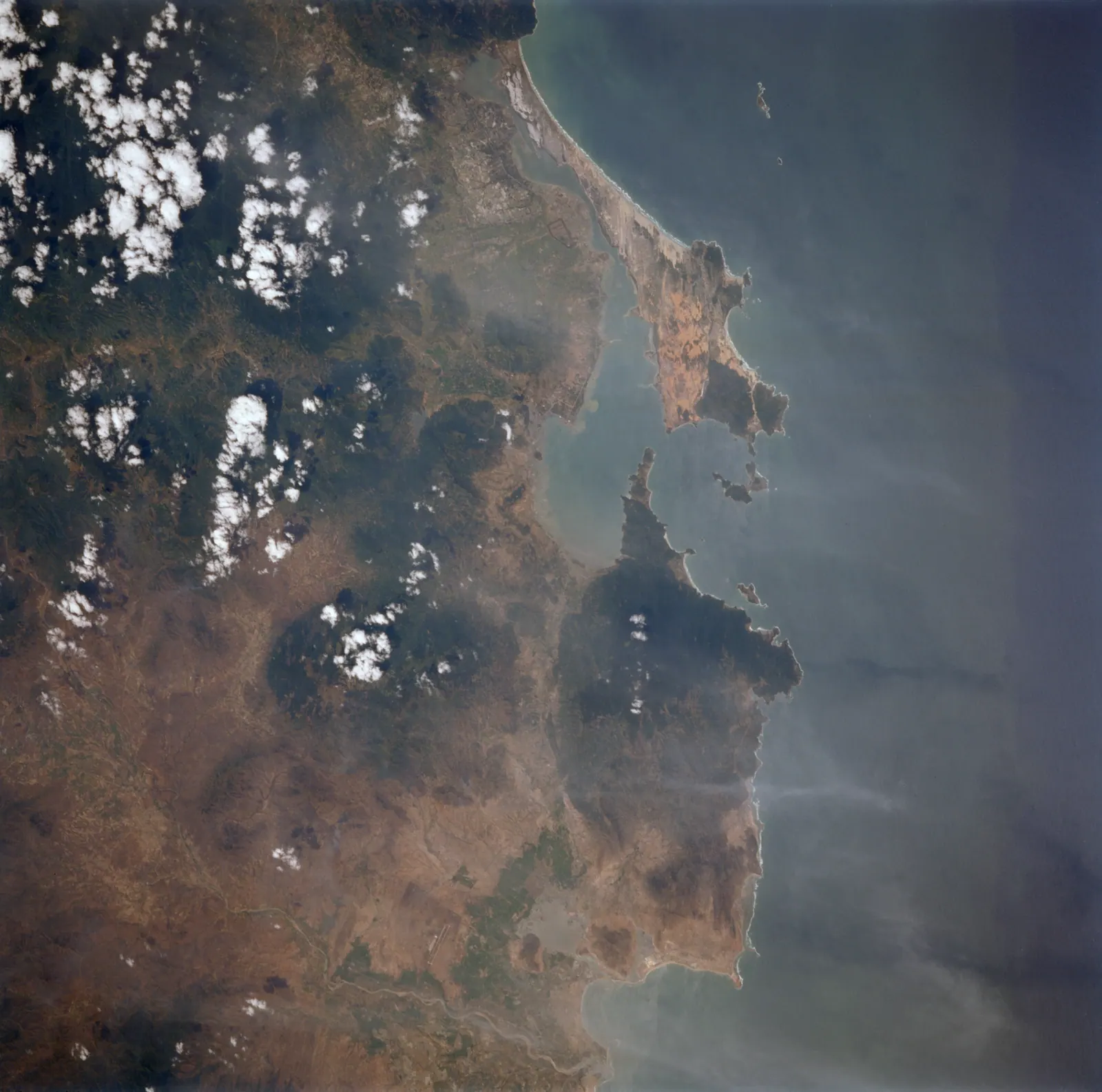
None of it needs a boat. All of it is on public roads on the mainland shore, which matters here, because the islands at the bay mouth are closed to tourism and the navy owns a large share of the waterfront. The post on why I am not writing a Binh Ba guide covers the first; this one covers the second, briefly, at the end.
Ba Ngoi market before eight
Ba Ngoi is the main ward of what was Cam Ranh city, 78.18 km2 with about 31,700 residents in 2024, on the west shore about 19 km by road from the airport on the peninsula opposite. Its market is the everyday produce and seafood market for the southern half of the bay, and it is a working market rather than a tourist one: no souvenirs, no English, and the seafood trade largely over by mid-morning.
Ba Ngoi is also one of the three landing points, with Đá Bạc and Đầm Thủy Triều, that supply the wholesale seafood houses of Cam Ranh, which is why buying near the port is cheaper and fresher than buying in any general market in the province. I go for the fish and the squid off the morning boats, and for the salt, sold plain and as the green-chilli and shrimp-salt blends that every stall keeps for dipping mango. Bring small notes; nobody takes a card, and prices are not fixed for outsiders, so watch what the woman ahead of you pays. The afternoon in Ba Ngoi post has the rest of the town.
The salt pans at first light
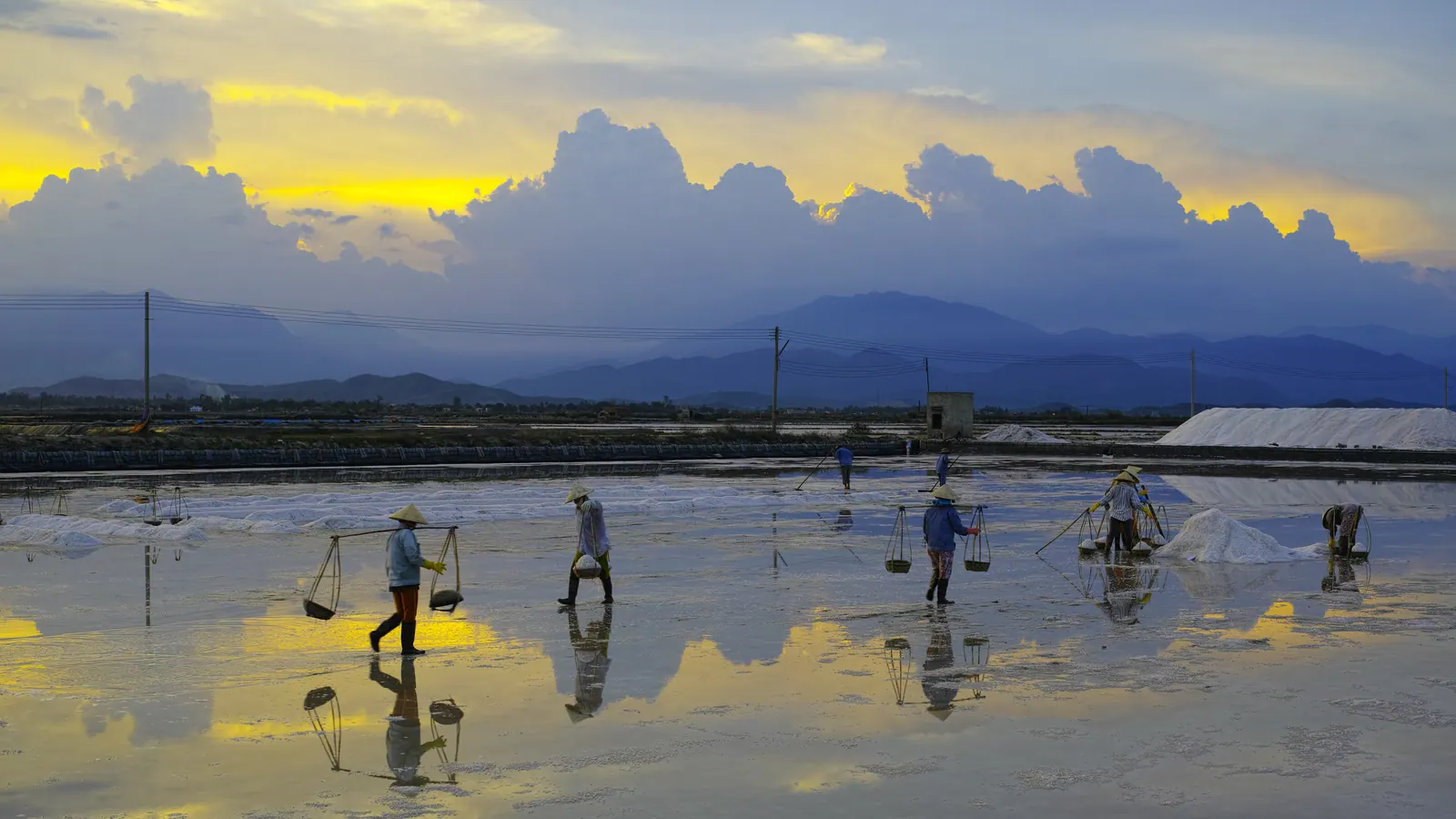
South of Ba Ngoi, along the QL1A and the coast road through Nam Cam Ranh commune towards the Binh Lap turn-off, the shore turns into a grid of shallow pans. The commune was formed on 16 June 2025 from the old Cam Lập, Cam Bình, Cam Thịnh Đông and Cam Thịnh Tây communes, and salt has been one of the sea livelihoods here alongside boatbuilding, fishing, cage farming and fish sauce for as long as anyone has written about the place.
The method has not changed. Seawater is pumped into the pans and left in the sun; in unbroken heat the crystals form in five to six days and a pan is harvested after seven to ten, raked into white cones by the diêm dân, the salt workers, and carted off the flats. The main run is December to August, and the hardest, hottest work is in July and August. The merged province now holds over 4,400 ha of salt pans, with more than 3,000 ha of them in the southern belt of the coast, so the Cam Ranh pans are a small corner of a big industry. I never found a published output figure for them alone.
You can see all of it from the road for nothing. The pans are family plots, so ask before you walk onto one, and go early: by mid-morning the glare is brutal and the workers have gone. Hon Khoi at dawn, north of Nha Trang, is the bigger and better-known version of the same scene; Cam Ranh’s is the one with nobody else there.
| What | When | Source |
|---|
| Salt harvest | December to August; hardest in July and August | Nhan Dan, Doanh Nghiep Hoi Nhap |
| Best light on the pans | Dry months, January to July, at first light | Cam Ranh Guide |
| Lobster and squid peak | May to August; prices creep up in autumn | Vinh Xanh Cam Ranh seafood house |
| Crab and oysters | February to April | Vinh Xanh Cam Ranh seafood house |
| Mackerel and sea snails | Autumn | Vinh Xanh Cam Ranh seafood house |
The lobster rafts from the road
Turn east through Cam Lap and the bay opens out on your left, and with it the rafts: wooden floating frames with cages slung beneath them, a hut on each, a coracle tied alongside. This is where the spiny lobster the province is known for is grown, fed on fresh trash fish, crab, sea urchin and molluscs rather than pellets, which the sellers credit for the firm, sweet meat.
The numbers are from the agriculture press, and they belong to the island commune at the bay mouth rather than to this shore, but they are the scale of the trade. Cage farming started on Binh Ba in the 1990s with a handful of households. The old Cam Bình commune came to farm roughly 90 ha of cages, 58 ha off Binh Ba and 30 ha off Binh Hung, with 469 rafts and nearly 10,000 cages; another count gives over 400 rafts and about 15,000 cages producing roughly 300 tonnes a year, mostly green lobster. About 85 per cent of households in the commune farmed lobster, and a farmer with 40 cages reported roughly 300 million VND profit in a normal year. The trade built the four and five storey houses on the island and the guesthouses that the June 2026 ban closed to visitors.
An old Khánh Hòa couplet lists the province’s four foods as the lobster of Binh Ba, the dried venison of Diên Khánh, the snakehead of Võ Cạnh and the blood cockles of Thủy Triều. The lobster is the one you can still eat within sight of where it was grown, and you do not need the island for it.
The navy and the camera
Cam Ranh is first a naval base town. The bay is the Vietnam People’s Navy’s main base and submarine facility, and Cam Ranh International Port, the dual-use port that opened on 8 March 2016, sits on the same water; its rules were amended by Decision 38/2025/QĐ-TTg from 1 December 2025, under which even tourists arriving by sea stay under the supervision of the base protection force.
Since 1 January 2025, Law 25/2023/QH15 has prohibited recording, filming, surveying, mapping or publishing material about defence works and military zones. I do not know exactly which stretches of the Ba Ngoi waterfront are signed as prohibited, and I could not find a published penalty; what I do is simple. The salt, the market, the rafts and the water are fine. Grey hulls, the port, gates and anything behind a military sign are not, and a drone stays in the bag for the whole morning. The Cam Ranh Guide page on the salt fields and its page on Ba Ngoi market carry the same rule.
Field note: the rafts nearest the Cam Lap road sell and cook what they grow. Point, watch it weighed, agree the rate and the cooking fee, and eat it on the planks with the bay underneath you.
What I eat at the end
Lobster, once a season, and the cheaper things the rest of the time. The seafood houses’ own sites, read in September 2026, put green lobster at roughly 800,000 to 1,200,000 VND a kilo and flower lobster, the premium grade that can reach 2 to 3 kg a head, at 1,500,000 VND and up, over 2,000,000 cooked fresh on a raft. A 2025 listing for the Cam Ranh seafood market quoted tiger prawn and crab at 200,000 to 400,000 VND a kilo and grouper and mackerel at 150,000 to 300,000, figures from a local tourism site that I would treat as a guide rather than a promise.
The rule that matters more than any price is that nothing is sold by the plate. You point at a live animal, it is netted and weighed, and you pay by weight at that day’s rate plus a cooking charge. Ask the rate for each item and the cooking fee before anything leaves the tank, and watch the scale. Steamed in beer or grilled with salt and chilli, with the head made into congee, is how it comes.
What I’d do
- Leave Nha Trang before dawn, or the Bai Dai strip at first light, and be at Ba Ngoi market by seven; buy salt and a bag of dried squid, and look, mostly.
- Ride south on QL1A into Nam Cam Ranh commune and stop at the pans while the workers are still on them, from the road, without stepping onto a plot uninvited.
- Turn east through Cam Lap towards Binh Lap and stop wherever the rafts are closest to the road. Eat there, price fixed first.
- Back along the same road by early afternoon, or carry on around the bay loop if the day is young.
- Say no to any boat that offers to show you the bay mouth. The islands are closed, the ban applies to everyone, and the lobster tastes the same on the mainland.