Cam Lâm is the flat, dry district between Cam Ranh airport and Nha Trang that every visitor drives through and almost nobody stops in, and it grows most of the province’s mango. Khánh Hòa had 9,059 ha of mango in 2026, 7,808 ha of it bearing fruit, producing over 53,000 tonnes a year, and the province’s own phrase for Cam Lam is the mango capital. The harvest peaks from April to June. If you land in that window, the fruit at the roadside stands on the airport road is the best thing you will eat before you reach your hotel.
I stop at those stands most weeks in season. This post is the district behind them: what is grown, how much, when it ripens, what it is worth, and a short loop through the orchards for a morning when the beach is windy.
What grows here, and how much?
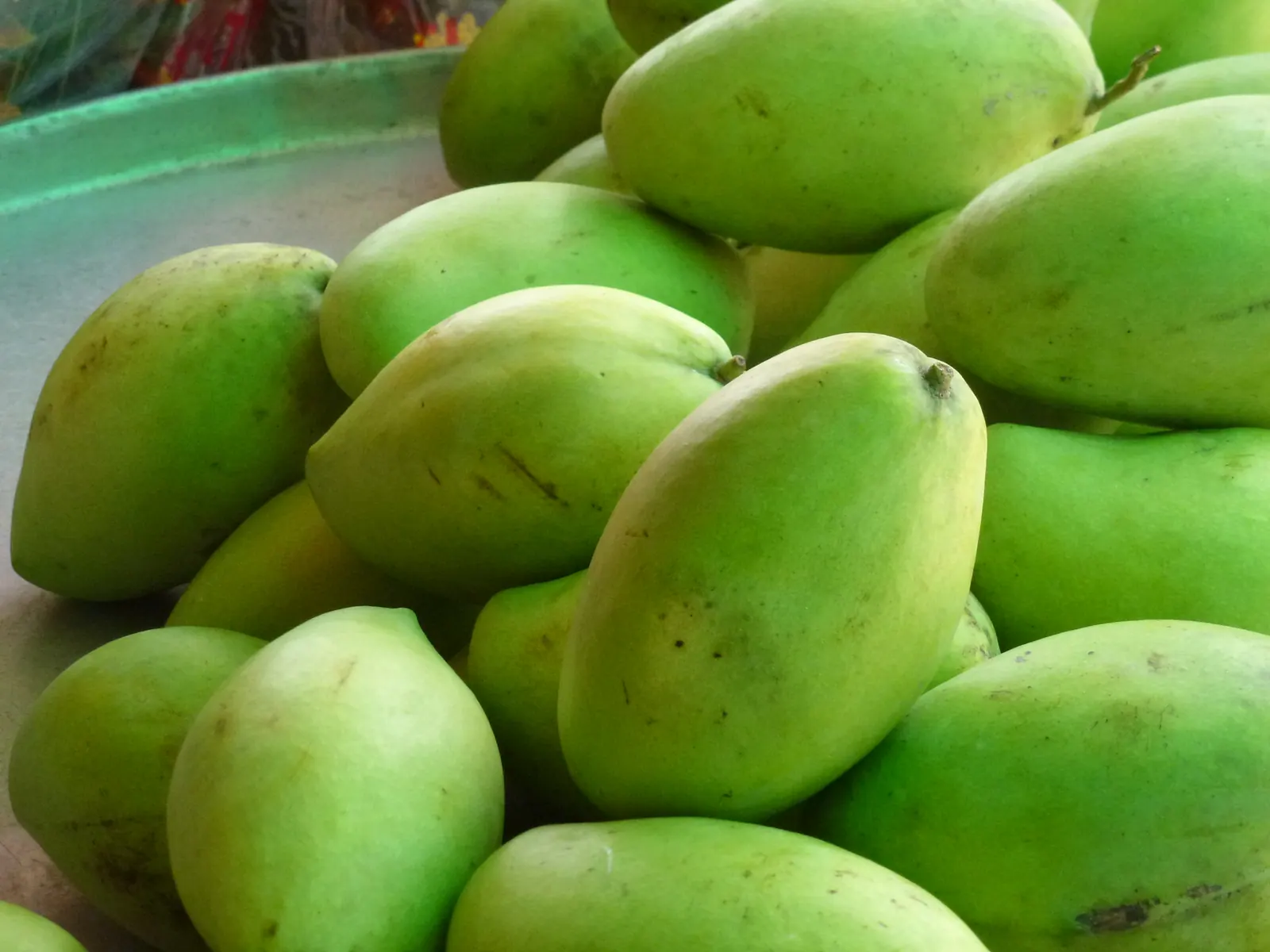
The signature variety is xoài Úc, the Australian mango: a big fruit that blushes red and gold, with a small stone, little fibre and a perfume you can smell from the road. It was introduced to Cam Lam in 2015 and covered about 4,500 ha of the former district by 2025, which makes it the main crop in a decade. Beside it the orchards grow cát Hòa Lộc, the classic southern mango, along with Canh Nông, Đài Loan (Taiwanese), tứ quý and the native Thủy Triều type.
The scale is easier to see in one place. In May 2023 the district had over 7,570 ha of mango; by June 2026 the province counted 9,059 ha, with 4,054 ha registered under 41 growing-area codes, 36 of them for export. The main export market is China, with the United States, Australia, New Zealand and the EU behind it. The post-reform Cam Lam commune, which is only part of the old district, holds about 1,200 ha of that, over 856 ha of it Australian.
When is the season?
The main harvest runs April to June, and the orchards flower around mid-March, when the whole district smells faintly sweet. In 2026 picking started in late May; in 2023 Báo Khánh Hòa reported the end-of-season harvest on 22 May, and in 2025 the orchards were in full harvest in mid-May. So the honest window for the best fruit is late April to the middle of June, and I would not plan a trip around it after that.
Food sites describe a smaller second crop from November to February. I have bought Cam Lam mango in December and it was fine, but it was not the April fruit. The fruit calendar has the rest of the province’s harvests, and if you want the other big one, Khanh Son in durian season is the plateau road an hour inland.
What is it worth?
This is the part the roadside stands do not tell you. The Australian mango has had three bad seasons in a row, and the prices growers get have collapsed.
| Year | Farmgate price, Australian mango | Source |
|---|
| Good years | 30,000 to 50,000 VND per kg; some years 70,000 to 100,000 | Bao Khanh Hoa, 2025 and 2026 |
| End of season 2023 | Grade 1 26,000 to 28,000 VND; grade 2 10,000 to 13,000; grade 3 under 6,000 | Bao Khanh Hoa, May 2023 |
| May 2025 | Class 1 20,000 VND (about 10 per cent of the crop); class 2 6,000 to 7,000; poor grade 2,000 to 3,000 | Bao Khanh Hoa, May 2025 |
| 2026 | 1,000 to 3,000 VND per kg; 5,000 to 7,000 for export grade | Bao Khanh Hoa, June 2026 |
In May 2025 about 1,800 tonnes went unsold across the former district, over 500 tonnes of it in Cam Hòa commune alone, and Tuổi Trẻ reported growers leaving fruit unpicked on the trees. I mention this because a visitor haggling at a stand over a bag of mangoes is haggling with someone who was paid 2,000 VND a kilo for them. I do not haggle. I never found a published roadside price, so I pay what is asked, and it has never been much.
Can you go into an orchard?
Yes, and since 2023 a few orchards have set themselves up for it. Báo Khánh Hòa described orchards in Cam Thành Bắc and Cam Đức opening to visitors in March 2023, and in June 2026 Dân Việt reported two in Tân Hải hamlet, one of 7,000 m2 planted mostly with Australian mango and one of nearly 4 ha of decades-old trees up to 30 m tall, taking visitors to pick and eat fruit under the trees. They work through a company called CamLamOnline rather than as walk-ins, and the visitors they described were from Russia, South Korea and China. On the way out they sell mango rice paper, juice, sweets and tea.
I could not find a published price for an orchard visit, and the two I have been into were by invitation from the stand where I buy, which is not a method I can pass on. Ask at a stand; the orchards are the stands’ families.
Field note: bánh tráng xoài, sheets of mango pulp sun-dried into a chewy sour-sweet leather, is the thing to take home. It keeps for weeks and weighs nothing, and the market version is better than the airport version.
A loop through the orchards
The orchards line the QL1A and the back roads of Cam Lam commune, west of the Bai Dai coast and 10 to 20 km north-west of Cam Ranh airport. The loop I ride is simple and I have not measured the cross-link, so take the middle section as a direction rather than a distance.
Start on Nguyễn Tất Thành boulevard north from the airport, which is the coast road along Bai Dai; the resort strip begins a few kilometres north of the terminal and Nha Trang is about 30 km from Cam Ranh by Tuoi Tre’s figure for the coastal chain. Stop at the Gạc Ma memorial on the boulevard. Then cut west on any of the lanes across the flat to the QL1A, ride south through the orchard country with the stands on both sides, and come back east to the airport road. Half a morning, more if you stop at every stand, and the whole thing is flat. The bay loop is the same idea for the south side of the airport.
What I’d do
- Come in late April, May or the first half of June, when the Australian mango is on the trees and at the stands.
- Ride the boulevard north from the airport, stop at the Gac Ma memorial, then cross west to the QL1A and ride south through the orchards. Do not measure anything; buy at the first stand that has fruit piled on the ground rather than in a fridge.
- Ask the stand whether their orchard takes visitors. If it does, go, and expect to pay something; if it does not, CamLamOnline is the organised route.
- Buy a kilo of ripe Australian for now, a bag of green ones with salt-chilli for the ride, and bánh tráng xoài for the flight home.
- If you are only passing through on the way to a hotel, the Cam Ranh Guide page on airport transfers explains the options; ask the driver to stop at a stand, and most will.