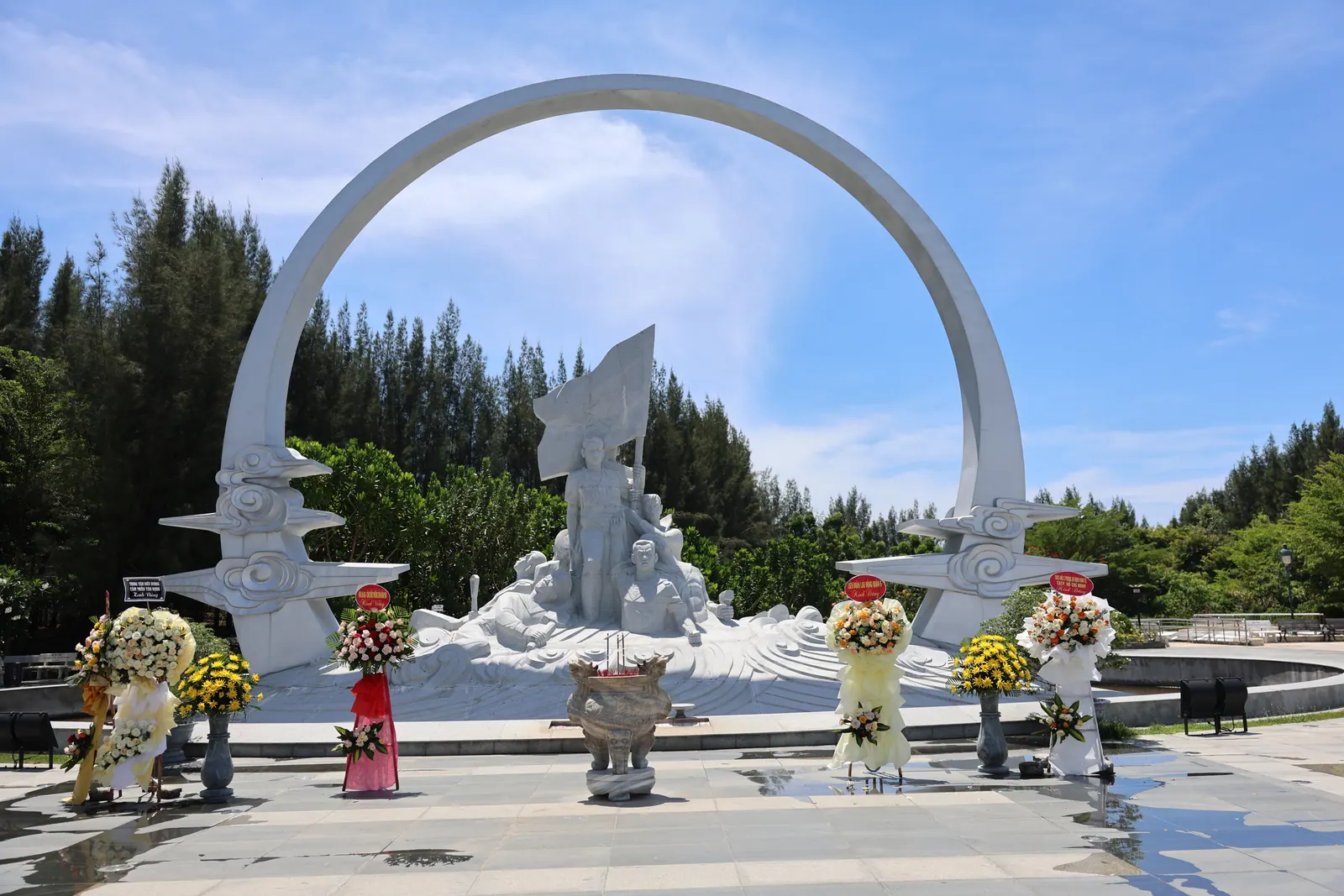
The Gạc Ma memorial is free, it stands on Nguyễn Tất Thành boulevard at Bãi Dài on the road every airport transfer uses, and an hour there is the most worthwhile hour on the resort strip. It commemorates the 64 Vietnamese naval soldiers killed on 14 March 1988 defending Gac Ma reef, known in English as Johnson South Reef, in the Trường Sa archipelago, in a clash with Chinese forces.
The second half of this post is about Truong Sa itself, which since July 2025 is a special zone of Khánh Hòa and therefore, on paper, part of the province I live in. You cannot go. I explain why, and where the islands are presented on the mainland instead.
What happened on 14 March 1988?
I am going to keep this to what the sources say, because the memorial does too. On 14 March 1988 Chinese and Vietnamese forces clashed at Johnson South Reef, with Collins and Lansdowne reefs also involved, in the Union Banks of the Spratly Islands, as Vietnam tried to establish a presence on several reefs and China moved to occupy Johnson South. Vietnamese reports put the Vietnamese dead at 64. China holds the reef today. The short history of Khanh Hoa sets the province’s naval geography in a longer frame, and I would read that first if the date means nothing to you yet.
What is at the memorial?
It was built by the Vietnam General Confederation of Labour with money raised through a programme for the Hoàng Sa and Trường Sa islands launched in March 2014. Ground was broken in March 2015 and the first phase opened on 15 July 2017. The government portal gives the site as 2.5 ha; Tuổi Trẻ gives over 20,000 m2 for the first phase and a cost of about 130 billion VND.
The monument is called “Những người nằm lại phía chân trời”, those who stayed behind at the horizon: a white sculpture 15.15 m tall, set beneath a great circle. A Cam Lam site describes it as nine figures standing for the 64; the government portal describes 64 soldiers holding hands. The two descriptions do not match and I give you both. Below it is a circular underground exhibition hall with 64 symbolic flowers and artefacts on the two archipelagos and the soldiers. Beside it are the wind graves, mộ gió, the Vietnamese term for a grave that holds no body, inscribed with all 64 names, and Hòa Bình square with its dove. An electric tram and wheelchair paths cover the grounds.
| Fact | Detail | Source |
|---|
| Fundraising programme launched | March 2014 | Bao Chinh Phu |
| Ground broken | March 2015 | Bao Chinh Phu |
| Phase 1 opened | 15 July 2017 | Bao Chinh Phu |
| Site | 2.5 ha; over 20,000 m2 in phase 1 | Bao Chinh Phu; Tuoi Tre, 2023 |
| Cost of phase 1 | about 130 billion VND | Tuoi Tre, March 2023 |
| Monument height | 15.15 m | Cam Lam Online, 2022 |
| Management | Khanh Hoa Labour Federation, since March 2021 | Tuoi Tre |
| Visitors since opening | nearly 500,000 | Khanh Hoa tourism information centre, undated |
| Truong Sa Museum ground broken | 29 April 2026, due first quarter 2028 | Tuoi Tre, April 2026 |
How do you behave there?
It is a war memorial in active ceremonial use, managed by the provincial Labour Federation since March 2021, and it asks for the obvious. Dress as you would for a temple. Keep quiet in the underground hall and at the wind graves; families do come. On 14 March the site fills with official commemorations, and unless you want to stand at the back of one, pick another day. Early morning or late afternoon is best, for the light on the white stone and the heat.
Admission is free. I never found opening hours on any official page, and I have never arrived in daylight and found the gate shut, which is all I can tell you. Give it an hour; the hall takes most of that. If you are between flights, the Cam Ranh Guide page on the airport will tell you whether you have the time, and the Bai Dai post covers the beach on the other side of the road.
Where is Truong Sa, and why can you not go?
Truong Sa is the Vietnamese name for the Spratly Islands, and the Vietnamese-held part of them is administered from Khanh Hoa. Under Resolution 1667/NQ-UBTVQH15 of 16 June 2025 the former Truong Sa district’s town and its two communes, Song Tử Tây and Sinh Tồn, became a single special zone, đặc khu Trường Sa, one of the 65 commune-level units of the merged province (48 communes, 16 wards and this one zone). Vietnamese Wikipedia gives it 9.35 km2 and a 2025 population of 153; Thanh Niên says nearly 100 households, and counts 21 islands and reefs held, among them Trường Sa, Song Tu Tay, Sinh Ton, Nam Yết, Sơn Ca, An Bang and Cô Lin. The nearest is 248 nautical miles from Cam Ranh.
There is no civilian tourism, and there never has been. Thanh Nien set out in 2015 who can go: official delegations, journalists on Navy ships, fishermen in an emergency, and citizens or overseas Vietnamese on state-organised trips. A May 2025 VOV report confirms nothing has changed; a culture ministry official and the Song Tu Tay deputy chairman talk only of hopes and proposals, and sea travel is feasible from April to June. If a website offers you a Truong Sa tour, it is either not lawful or it is selling Changsha, the Chinese city, which is also written Trường Sa in Vietnamese.
What changed in 2025?
Two things, and they are why the word district no longer applies. On 16 June 2025 the National Assembly amended the Constitution and passed a new law on local government, and from 1 July 2025 Vietnam has had no district level at all: provinces, then communes, wards and special zones. The special zone is the commune-level unit reserved for island territories, and Khanh Hoa’s is Truong Sa. On the same day the merger of Ninh Thuận into Khanh Hoa took effect. The merger post has the practical side of both; the point here is only that the far islands are now formally a neighbour of Nha Trang ward rather than a district of their own.
Where can you see the islands presented?
Today, in the underground hall at the memorial, which holds the artefacts on Hoàng Sa and Truong Sa and on the 64 men. From early 2028, if the schedule holds, in the Truong Sa Museum next door: it broke ground on 29 April 2026 on over 1.7 ha, with a central building of nearly 3,900 m2 on three floors plus a basement, a budget of nearly 300 billion VND, and 1,154 images, documents and artefacts already collected for it by the Khanh Hoa Museum.
I know of no permanent Truong Sa exhibition in Nha Trang city itself, which surprised me when I went looking; the memorial hall at Bai Dai is the one you can walk into this year.
Field note: the wind graves are the part that stays with you. Sixty-four names, nothing beneath them, and the sea just across the boulevard.
What I’d do
- On the way to or from the airport, on any day but 14 March, leave an hour. Late afternoon if you can choose.
- Walk to the monument first, then down into the hall, then out to the wind graves and the square. Take the tram only if the heat or your legs demand it.
- Do not plan anything around Truong Sa itself; there is nothing to plan. Put the museum in your diary for 2028 and check it actually opened.
- Ride on to the salt and lobster road on the far side of the bay if you want the rest of the naval geography, from public roads, without a camera pointed at it.