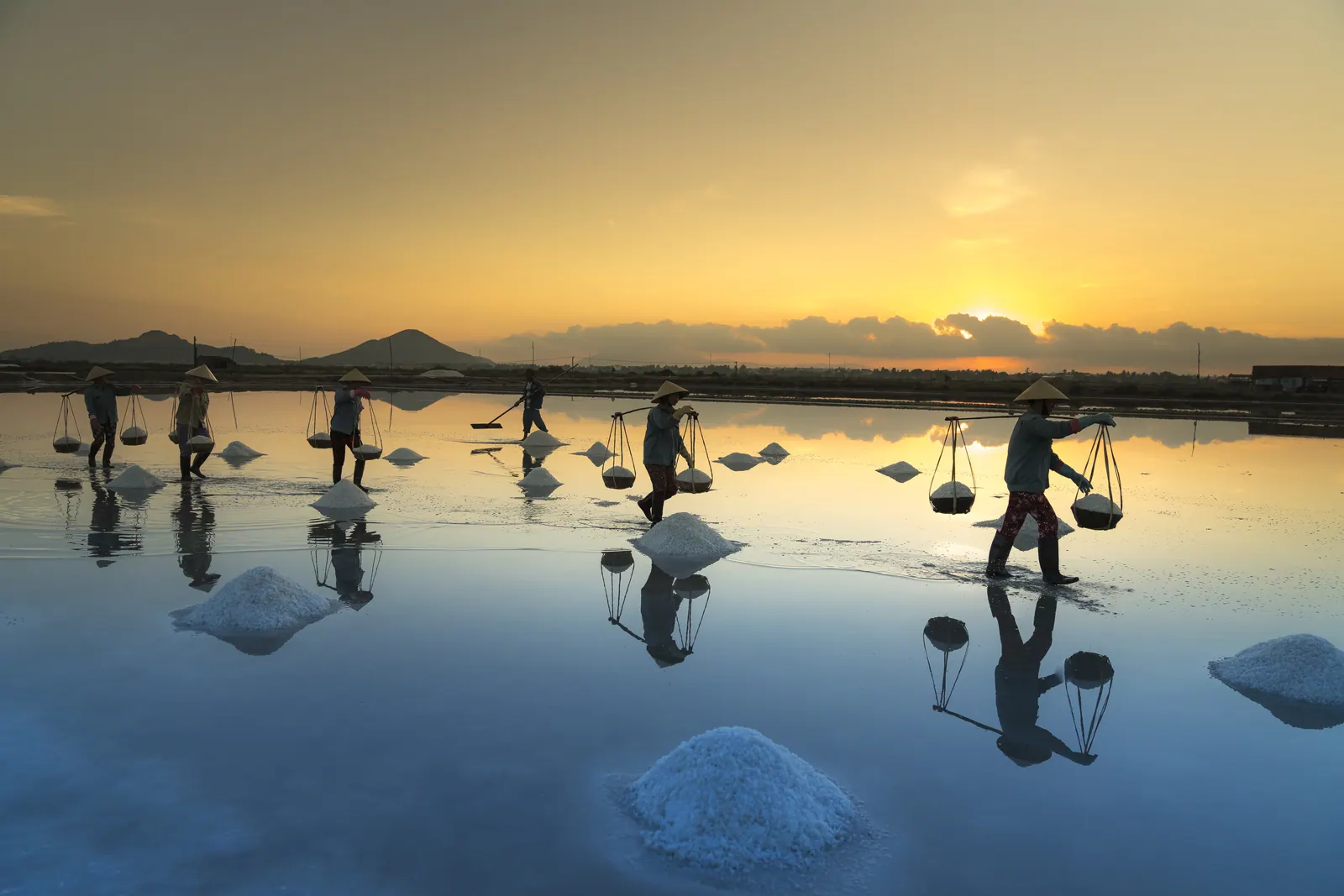
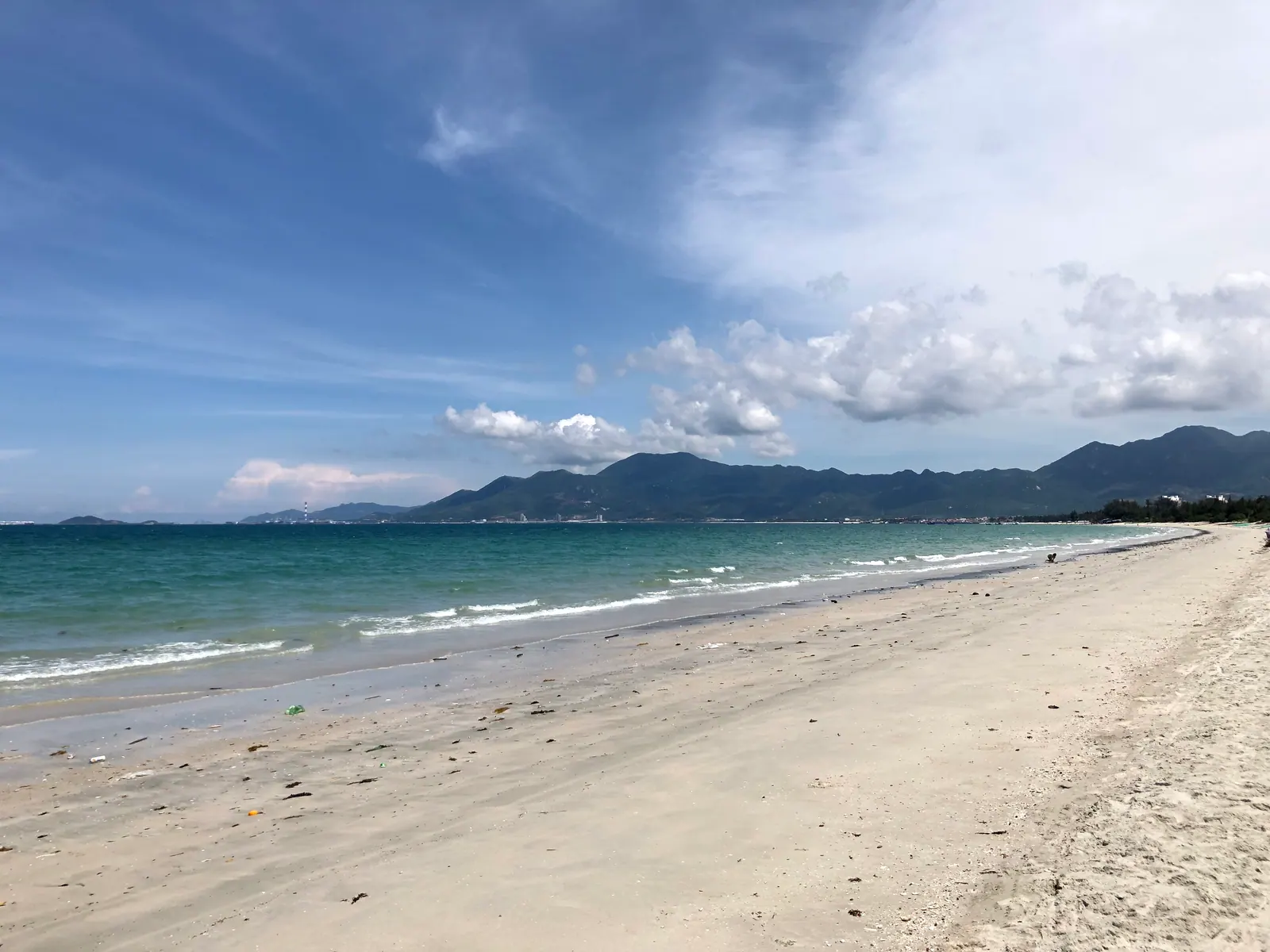
The Hòn Khói salt fields are about 400 hectares of evaporation pans on the flats behind Dốc Lết beach, roughly 1 km from the sand, and the reason to be there at dawn is that the work is. In season the first shift is on the pans from 04:00 to 09:00, because yesterday’s filtered seawater has to be spread before the sun gets to it and the salt raked overnight has to be carried out before the heat. The photographs everyone has seen, lines of women with shoulder poles reflected in flooded pans, are taken between four and nine in the morning, and not by accident.
Season is the other half of the answer. Salt is made from March to September, most of it in the hottest months from April to July. Come in November and you will find wet flats, no workers and nothing to photograph. There is no fee that I have found and no visitor infrastructure of any kind; it is private working land with a road through it.
Where are the fields, and how do you get there?
On the Hòn Khói headland in what is now Đông Ninh Hòa ward, which absorbed the old Ninh Diêm, Ninh Hải and Ninh Thủy wards and Ninh Phước commune in July 2025. The road from Ninh Hòa town runs east through Ninh Diêm towards Dốc Lết and the pans line it for the last stretch, about 1 km before the beach. From Nha Trang it is 33 km up Highway 1 to Ninh Hòa and 46.3 km in all to Dốc Lết, about an hour by car or motorbike, and in my experience a fraction less at five in the morning when the trucks are still asleep.
The Ninh Diêm production zone is 500 ha in total, of which the Khánh Hòa Salt Company works 350 ha; the rest is in household hands as far as I can tell, and it is the pans along the road where the carrying lines are. The HD Hyundai shipyard is on the same headland, and its cranes are on the horizon from some of the pans, which is part of why this is a working landscape rather than a postcard.
Which months is there salt?
Salt is sun and no rain, so the season follows the dry months, and the province’s calendar is unforgiving about it. The Nha Trang station figures below are the nearest I have; the whole coast shares the same dry season from January to August and the same wet season from September to December, with a typhoon window from early September to about 10 December.
| Month | Salt at Hòn Khói | Rain, Nha Trang station |
|---|
| March | Season opens | 31 mm |
| April | Peak | 35 mm |
| May | Peak | 70 mm |
| June | Peak | 59 mm |
| July | Peak | 36 mm |
| August | Late season | 50 mm |
| September | Season ends | 159 mm |
| October | Nothing; flats flooded | 302 mm |
April to July is the answer. I have been in March, when the pans were only starting to fill and the crews were thin, and in late August, when the light was good and the harvest was winding down. The month-by-month guide to the province has the full rain table; anything after mid-September is a wasted dawn.
Why does the work happen before sunrise?
Two reasons, both practical. The salt raked overnight has to be finished the same day and not left standing, so it is gathered, carried out along the dykes and heaped before the heat. And the pans have to be refilled with the previous day’s filtered seawater early enough to catch the full day’s sun, or the day’s crystallisation is lost. So the crews work two shifts, 04:00 to 09:00 and 15:30 to 19:00 as of July 2023, and the hours in between belong to the sun.
More than 99 percent of households now crystallise on tarpaulin-lined pans rather than bare earth, which gives cleaner salt and, incidentally, the mirror surface that makes the dawn reflections. The trade-off for the photographer is the glare: by eight it is severe, and the pans go from silver to white to a flat blaze you cannot look at. First light to about 08:00 is the window, and it is short.
Field note: the sound arrives before the light. Rakes on tarpaulin, the creak of the poles, no talking. By the time you can see the lines the day is already half done for them.
What is the salt worth?
Less than the photographs. Raw salt reached 1,200 VND a kilogram in April 2023, nearly double the usual and a record; salt sold for about 1.5 million VND a tonne in 2023 and 900,000 to 950,000 VND a tonne in early 2024. A hectare gives about 35 tonnes per harvest, on April 2023 figures, and the field as a whole produces around 30,000 tonnes a year across all grades; Vietnamese Wikipedia’s 35,000 tonnes is for the whole former town, and the Khánh Hòa Salt Company’s own target for 2024 was 25,500 tonnes.
The wages are the number that stays with me. In April 2024, raking paid 300,000 to 350,000 VND a day and carrying paid 90,000 VND an hour for about four hours of work, which came to 12 to 14 million VND a month for a labourer; an older piece from 2023 quotes 50,000 to 100,000 VND a day. Both figures are in the sources and I give both because they disagree. Either way, the woman in the photograph with the shoulder pole is earning it at four in the morning.
How do you stand out of the way?
Nothing about visiting the pans is written down anywhere I could find: no fee, no rule about the dykes, no etiquette. So what follows is what I do, not what is published. I park on the road and stay on it or on the widest outer dykes, and I do not step onto a pan, ever; a footprint in a tarpaulin pan is somebody’s morning. I do not stand in a carrying line, which moves at a pace and does not stop for a camera. I ask before a close photograph and I take no for an answer, and if someone stops to pose I give them something for their trouble. Báo Khánh Hòa notes that the scene draws many photographers, and the workers have seen every lens; be the one who was not in the way.
The salt itself is the province’s other big story, with a second field at Cam Ranh in the south; the Cam Ranh salt and lobster road is the southern version, on flat ground by the bay.
What I’d do
- Leave Nha Trang at 04:00 in April to July, with fuel and a jacket for the ride; Highway 1 is cool and empty at that hour.
- Ninh Hòa by 04:45, east through Ninh Diêm, on the pans for first light around 05:15.
- Stay on the road and the outer dykes until about 07:30, when the light goes hard.
- The last kilometre to Dốc Lết for breakfast at the seafood market beside the resort strip, then the water while it is still empty; Doc Let on a weekday is why the day of the week matters.
- Back through Ninh Hòa for nem nướng in its home town at lunch, and home on Highway 1 before the afternoon trucks.
If you cannot manage the four o’clock start, the afternoon shift from 15:30 to 19:00 gives you the same lines in the other light, with the sun going down behind the pans instead of coming up over the sea.