Go to Ba Hồ between January and May, in the morning, in shoes you can climb in. Get the season right and it is one of the best half days near Nha Trang: three clear pools stacked up a forest stream, reached by a kilometre of scrambling that keeps the crowds at the bottom. Get the season wrong and it is either a trickle you paid to see or a wet granite staircase that will put you on your back.
I have been twice, once in the dry months and once just after the rains, and the difference was the whole trip. The rest of this post is about that difference, plus the fee, the hours and how to get there.
What is Ba Ho?
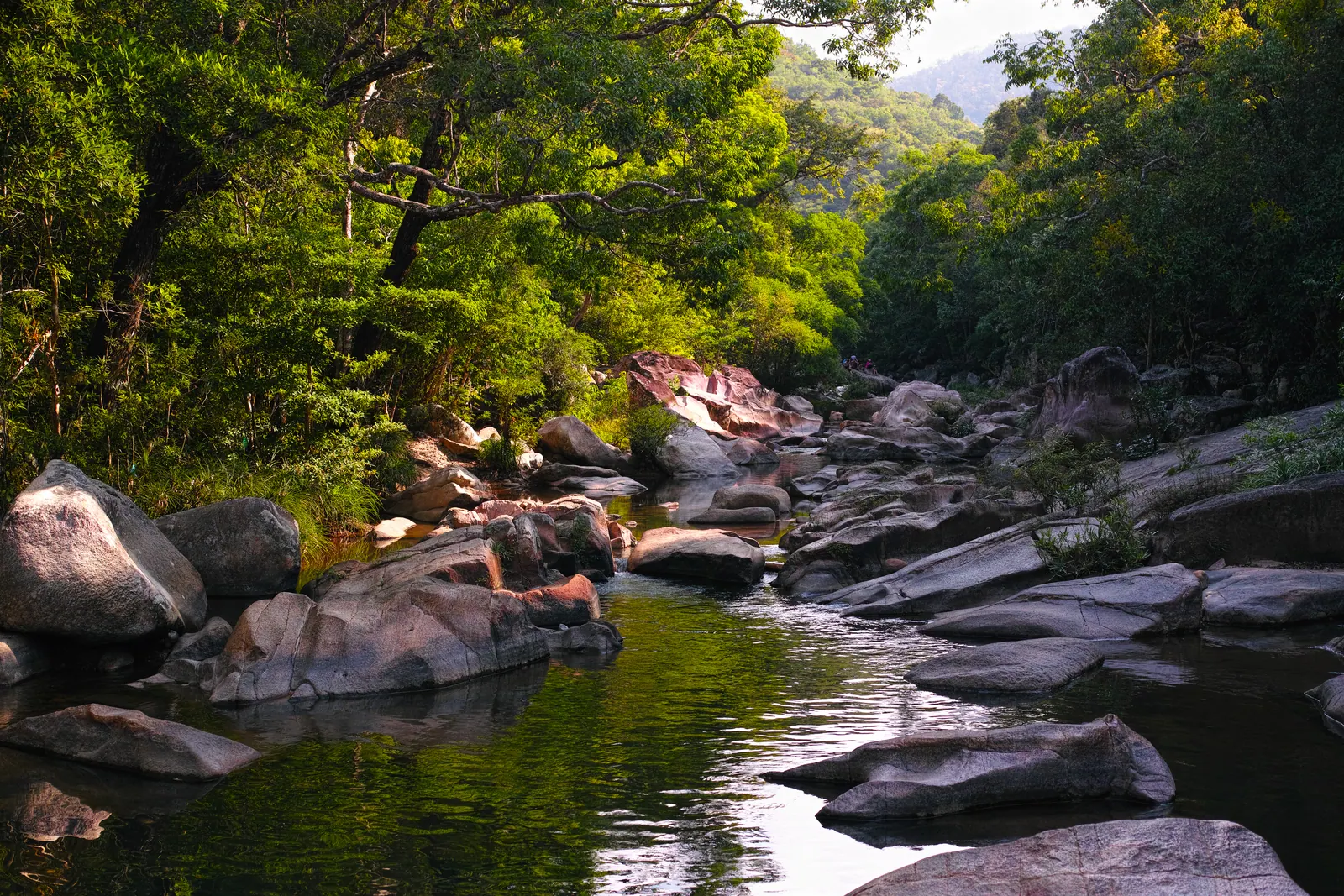
Ba Ho means three lakes. A stream off Hòn Sơn, a 660 m peak in what is now Nam Ninh Hòa commune (the old Ninh Ích), drops through primary forest into three pools one above the other, in Vạn Thuận hamlet 25 km north of Nha Trang. The site is run as an eco-tourism park: a gate, a car park, electric buggies to the trailhead, a swimming pool, kayaks and water bikes on a lake, a skywalk, and a zipline and camping sold separately. Then the stream, which is the reason to come.
The first pool is close to the end of the buggy track and is where most people stop. The second and third are up the boulders. The operator’s own description is about a kilometre of scrambling to the third pool, and that matches my legs: it is a route over granite rather than a path, some of it on boulders big enough that you use your hands, with the way not always obvious.
The season decides it
The whole Khanh Hoa coast runs on one calendar: dry from January to August, wet from September to December, with October and November the worst by a distance. The Nha Trang station normals put October at 302 mm and November at 332 mm of rain, against 16 mm in February and 31 mm in March. Ba Ho is a mountain stream and it reacts to that rain within hours.
| Months | Rain at the Nha Trang station | What it means at the pools |
|---|
| January to March | 38, 16 and 31 mm | Clear water, dry rock, the stream a little thin by March |
| April to May | 35 and 70 mm | Still good; hot enough that the pools are the point |
| June to August | 59, 36 and 50 mm | Fine on a dry day, thinner falls, more visitors at weekends |
| September | 159 mm | The rains start; rocks wet after any storm |
| October to December | 302, 332 and 153 mm | Full, loud and dangerous; flash floods possible |
The sister guide and the operator both give January to May as the season, and I agree with a small footnote. The very beginning of the dry season, when the stream still carries the last of the rain but the rocks have had a few dry weeks, is the best of both. By late in the dry season the falls are more of a slide than a drop, though the pools are still deep enough to swim.
My two visits
The first time, in the dry months, the granite was pale and dry, the water in the third pool was clear to the bottom, and the scramble was a pleasure. I saw a family with small children at the first pool and nobody at the third. The second time, after a run of wet weather, the stream was several times the size, the noise filled the valley, and every boulder had a film of water on it. I turned round below the second pool, and I was right to. Two people ahead of me went on in sandals and I watched one of them fall. Nobody was hurt that day.
I looked for a documented accident record at Ba Ho and did not find one, so I will not claim more than what I saw: slips are common and the rock does not forgive them. The operator’s own warnings are the ones I would repeat. The granite between the pools is slippery, so wear shoes with grip, and flash floods are possible in the October to December rains.
What does it cost, and when is it open?
The operator’s site listed a single adult ticket of 135,000 VND in September 2026, with no holiday surcharge, including a bottle of water, the swimming pool, the kayaks and water bikes and the skywalk. The zipline, camping and guided trekking cost extra. A tour site I checked quoted 185,000 VND for an adult and 85,000 VND for a child under 1.3 m, with the skywalk at 200,000 VND and the 400 m zipline at 300,000 VND on top, so prices plainly move and the official figure is the one I would trust on the day. I never found a child price on the official site.
Hours are 08:00 to 16:30. Outside food is not allowed in the main restaurant area, which matters if you were planning a picnic by the pool. The turn is signed off QL1 about ten minutes past Long Phú tourist port; from central Nha Trang it is 40 to 45 minutes by motorbike or car.
Field note: the buggy from the gate is included and worth taking, not for the distance but because the trail head is where the shade starts. The car park has none, and by ten in the morning it is an oven.
What I’d do
- Pick a weekday between January and May. Check the forecast the night before; one storm changes the rock.
- Leave Nha Trang around half past seven so you are at the gate when it opens at 08:00.
- Take the buggy to the trailhead, walk to the first pool, then keep going. Budget an hour up to the third pool with stops.
- Swim at the third pool, eat what you carried in away from the restaurant area, and come down before the tour groups arrive around midday.
- Ninh Hoa is only a few kilometres further up QL1, so finish with nem nuong in its home town, which turns a half day into a proper one.
If you are choosing between waterfalls rather than committed to this one, Ba Ho, Yang Bay or Ta Gu compared sets them side by side, and Khanh Hoa month by month has the full weather tables the season argument rests on.