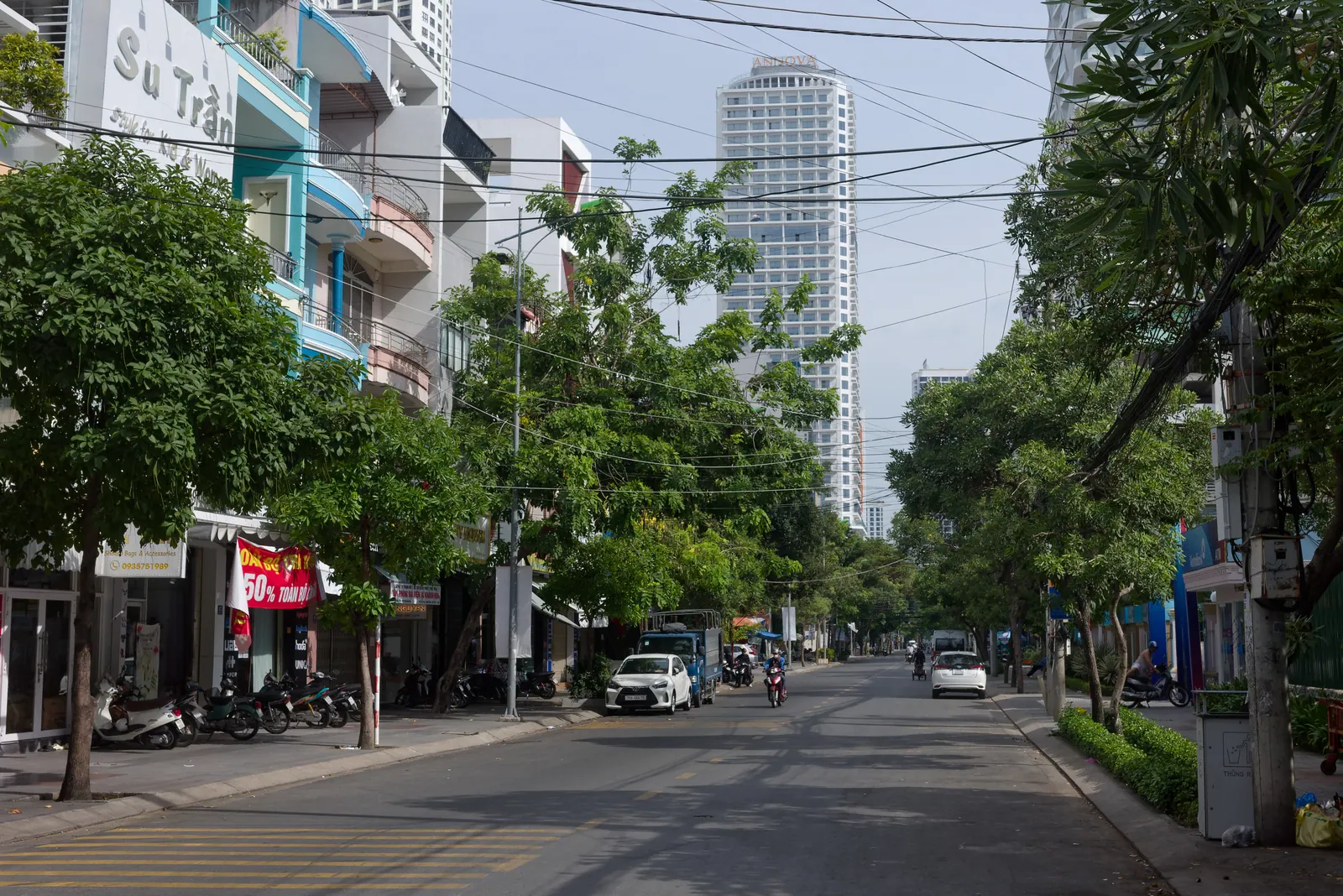
Rent a street or two inland from the beach, in the grid behind Trần Phú or the quieter blocks north of it, unless you need the sea from the window, in which case pay for the tower and accept the six-lane road between you and the sand. That is where I ended up after starting in a seafront tower, and it is where most people I know who stayed past a year ended up too. The published bands are Numbeo’s, updated 6 August 2026: about 10.55 million VND a month for a one-bedroom in the centre and 7.16 million outside it.
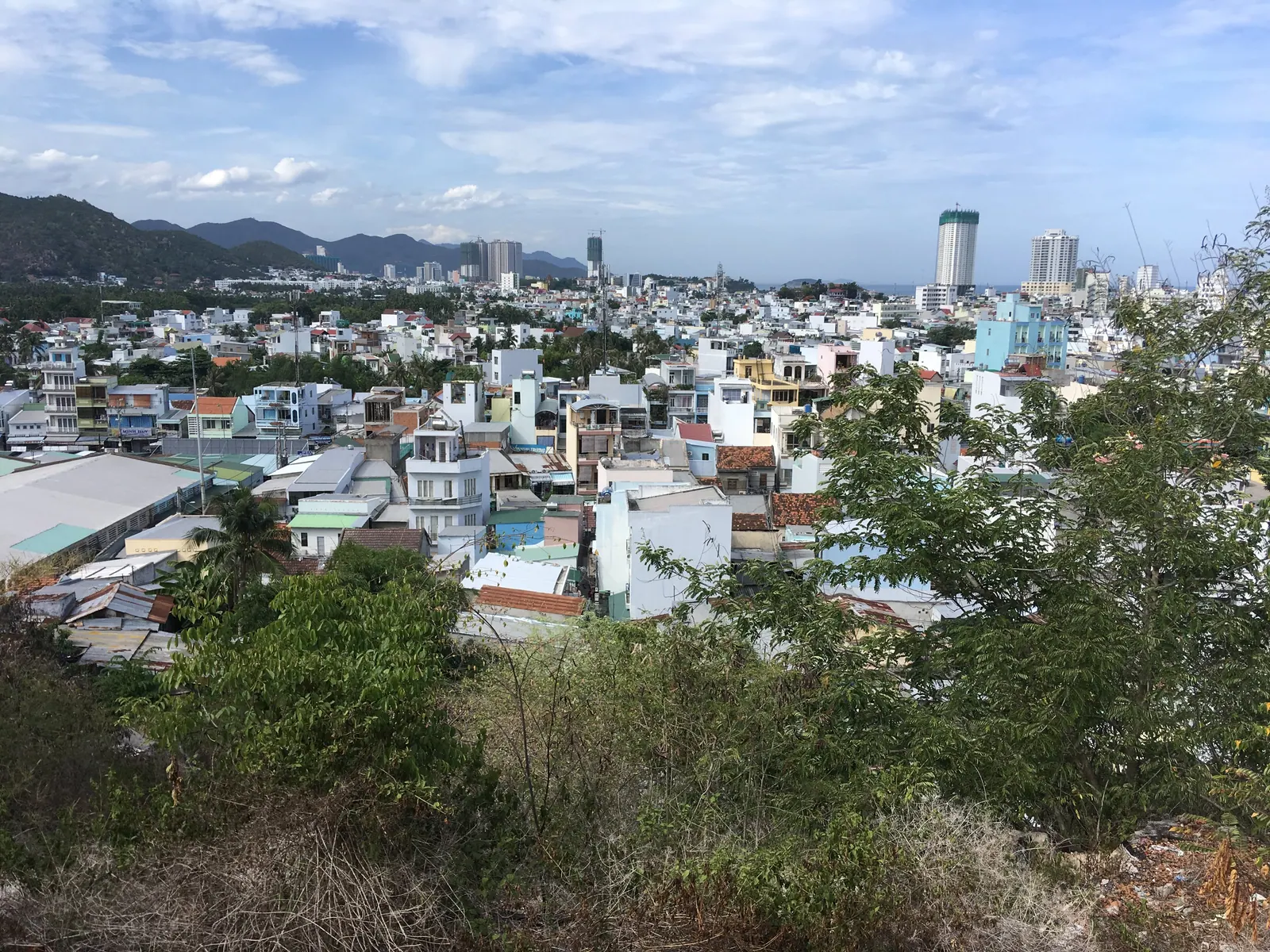
The city is small enough that every area below is a short ride from every other. What separates them is noise, who your neighbours are, how far the water is, and what the rain does to the street.
The beachfront towers on Tran Phu
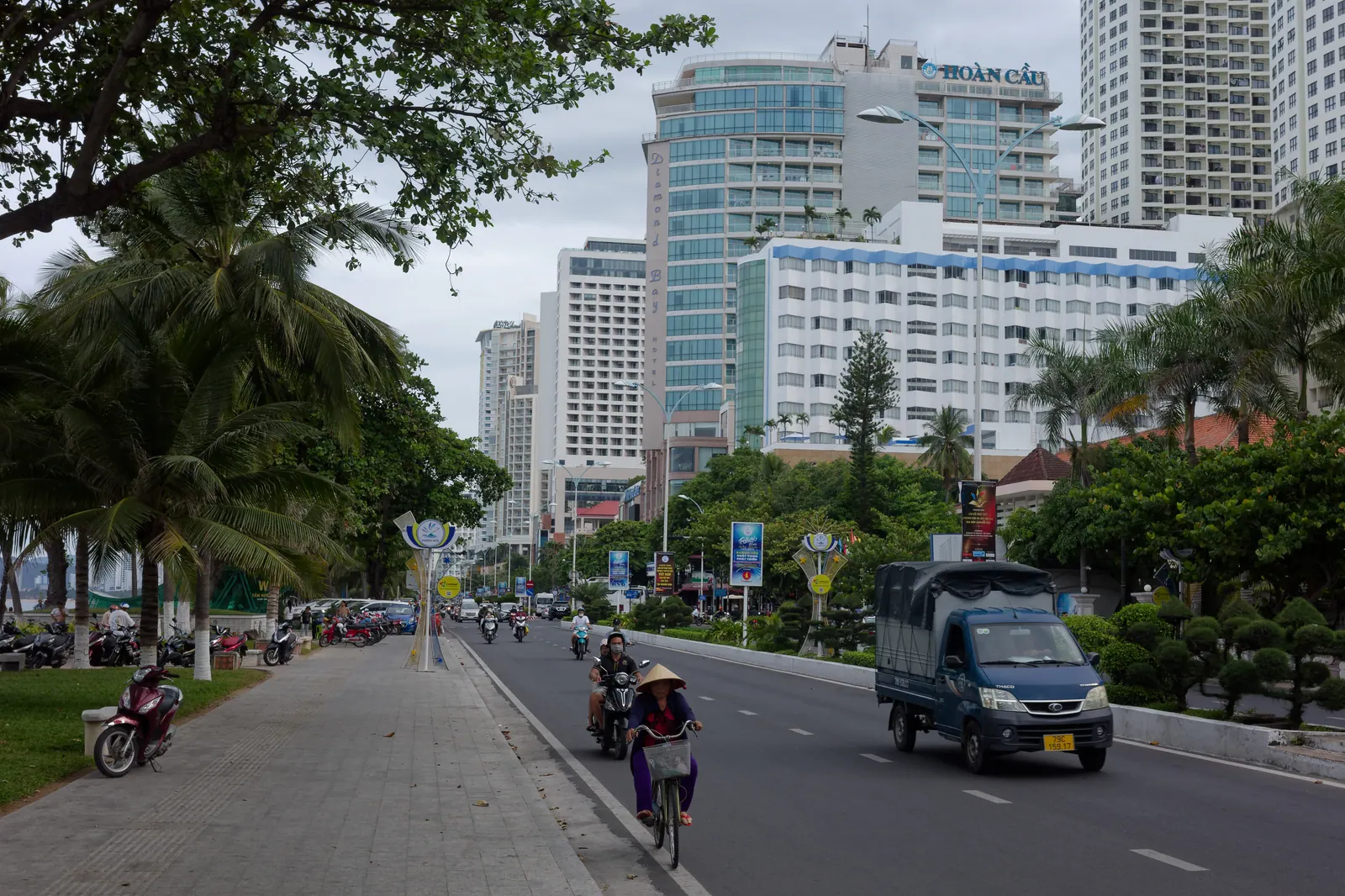
Tran Phu runs the length of the city beach, and the big towers stand on its landward side: the hotels first, and among them the serviced flats and apartment blocks that rent by the month. The sea is a crossing away, not a doorstep, because the six-lane road always sits between the buildings and the sand. The beach itself is wide, public and free, and the Tran Phu stretch is the only city beach with rescue stations staffed from morning to evening.
Who lives here: short-term visitors, and long-stayers who wanted the view and could pay the centre band or above. Noise is traffic rather than bars, except at the southern end. In the rain months the sea goes brown and the wind comes straight in. My first flat was here, and the view was worth exactly one lease. The Nha Trang Guide page on Tran Phu south is the hotel view of the same strip.
The western quarter, which the city calls pho Tay
The dense grid behind the beach, along Nguyễn Thiện Thuật, Hùng Vương, Biệt Thự, Trần Quang Khải and Nguyễn Thị Minh Khai, is where the restaurants, the dive shops, the bars and the mid-priced towers are, all a few minutes’ walk from the sand. It is also the Russian-speaking quarter, with menus and signs in Russian along Hung Vuong, Nguyen Thien Thuat, Biet Thu and Tran Quang Khai, and the Korean restaurants cluster on the same two main streets.
Who lives here: everyone passing through, plus the Russian-speaking business owners a 2019 study described, from Russia, Ukraine, Belarus, Armenia, Georgia, Kyrgyzstan and Tajikistan. The trade-off is night noise; Nguyen Thien Thuat and Biet Thu run late, and a flat on a high floor away from the road is a different life from one over a bar. It is the most convenient place in the city and the one I would least want to sleep in. Where the quarter shades into ordinary streets, one block further from the sea again, is where I live now.
North of the bridge: Vinh Hai, Vinh Hoa and Hon Chong
Cross the Xóm Bóng bridge over the Cái river and the city changes register. Along Phạm Văn Đồng and the Vĩnh Hải and Vĩnh Hòa stretch, around the Hòn Chồng promontory, are big apartment towers, a quieter local beach and much lower prices, at the cost of being a few kilometres from the tourist centre and dependent on a bike. Since 1 July 2025 all of this is Bắc Nha Trang ward. Vĩnh Hải market on 2 Tháng 4 street is the main market of the north, with the boat catch arriving in the morning, and the bờ kè seafood strip on Nguyễn Bình Khiêm is on the way.
Who lives here: Vietnamese families, Russian-speaking groups who have been coming to this stretch for years, and long-stayers who want space. This is the outside-centre band on Numbeo, and it is where I would look for a two-bedroom. The ride back to the western quarter for dinner is the price. I have not seen these streets flood; the river runs high and brown under the bridge for days in November and stays in its channel.
The south: Phuoc Hai, Phuoc Long and the new blocks
South of the old centre, the former wards of Phước Hải, Phước Long and Vĩnh Trường, now Nam Nha Trang ward, are the newer part of the city: wider streets, newer blocks, and room to park, which is why more than twenty Korean restaurants have gathered inland on Nguyen Thien Thuat, Hung Vuong and out in the VCN Phước Hải district rather than on the beach road. Further down, past An Viên towards Cầu Đá port and the cable-car station, the city beach has ended and the coast is resorts on their own coves; choose it for the boats, not for walking to dinner.
Who lives here: Vietnamese families in the new blocks, Korean long-stayers around VCN, and people who work at the port end. The rent band is the outside-centre one. It is the part of the city I know least well as a resident and best as a rider, because the road south to Cam Ranh starts here.
Dien Khanh, the countryside option
Diên Khánh, the old citadel town about 10 km west of Nha Trang, is the cheap option people mention and the one I never found a published rent figure for, so I will not give one; the nearest sourced number is Numbeo’s 7.16 million VND outside-centre band, and Dien Khanh is well beyond where that band reaches. What it offers is rice country, the citadel gates, the bánh ướt breakfast shops and a 10 km ride into the city that is a pleasure in the dry months and a wet commute in October and November. The Dien Khanh countryside loop is the case for it. I would live there with a second reason to be there, not for the rent alone.
The rent bands, with their date
| Flat | Centre | Outside the centre |
|---|
| One-bedroom | 10,552,606 VND | 7,159,914 VND |
| Three-bedroom | 19,500,000 VND | 16,645,109 VND |
| Basic utilities, 85 m2 | 1,994,792 VND | |
Numbeo, 6 August 2026, from 250 entries by 26 contributors over twelve months: a small sample, so read each figure as the middle of a band. I never found a listing site whose studio and one-bedroom bands I could cite with a date. The electricity question, which matters more than the area, is in what a month costs.
Rain, noise and the things a viewing does not show
October and November bring 302 and 332 mm of rain to the Nha Trang station in a normal year, roughly half the annual 1,280 mm, and the difference between areas is drainage rather than rainfall. After the heaviest downpours some low junctions in the western quarter and behind the beach hold water for an hour, then drain; I have not seen the beachfront itself under water, or the north. October and November in Nha Trang is the longer account. Ask, at a viewing, which way the water goes.
Noise is the other thing. The bar streets are obvious; the school, the karaoke room and the building site next door are not, and every one of them starts early. I view in the evening and go back in the morning. Then I check the walk to the nearest market, because the beachfront supermarket made my first month feel dear until I found the markets I actually use: Xóm Mới at 49 Ngô Gia Tự, Chợ Đầm in the centre, Vinh Hai in the north.
Field note: the best flat I have seen here was on a fourth floor one block behind the western quarter, with the bar noise a murmur and the sea a six-minute walk. I did not get it. I still ride past it.
What I’d do
- Take a short let for the first month on or near the beach, to learn the city on foot.
- Move inland in month two: the quieter edge of the western quarter, or the blocks behind the north end of Tran Phu around Lý Tự Trọng and Yersin, budgeting between the 7.16 and 10.55 million VND one-bedroom figures.
- For a family or a two-bedroom, look north of the bridge in Vinh Hai and Vinh Hoa first.
- View in the evening and again in the morning; ask about drainage and how the electricity is metered.
- Use the ward names in force since 1 July 2025 on any lease: Nha Trang, Bắc, Tây or Nam Nha Trang. The old names are still on every sign; the new ones belong on paperwork.